


 PLATFORM UPDATE:


In situ voltammetric analysis of 2,4-dichlorophenoxyacetic acid in environmental water using a boron doped diamond electrode and an adapted unmanned air vehicle sampling platform†
Abstract
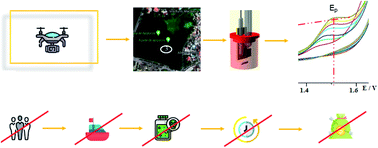
In the present work a voltammetric method was developed for in situ detection of 2,4-dichlorophenoxyacetic acid (2,4-D) in environmental water samples, using a compact and lightweight electrochemical cell using a fused deposition modeling (FDM) 3D printer with biodegradable polylactic acid filament, and a boron-doped diamond electrode (BDDE). The samples were collected by an adapted unmanned aerial vehicle (UAV) with a micropump and a miniature solenoid valve powered by an open source microcontroller. After optimizing the supporting electrolyte, pH and parameters of the square wave voltammetry (SWV) a linear analytical curve for 2,4-D in 0.5 mol L−1 Na2SO4 (pH = 2.0 regulated using 0.5 mol L−1 H2SO4 solution) in a concentration range from 100 nmol L−1 to 911 nmol L−1 with 34 nmol L−1 as the limit of detection was obtained. The same samples in situ analyzed by SWV were sent to the laboratory for gas chromatography-mass spectrometry (GC-MS) analysis; and there was no statistical difference from the concentration of 2,4-D in any of the samples at a 95% confidence level. Therefore, the method developed for quantification of 2,4-D in water provides an important environmental monitoring tool since it enables access to difficult areas in a fast, practical and safe way. This is the first time that an adapted UAV with these features has been used to collect environmental water for in situ electrochemical analysis as a screening tool to alert the presence of environmental hazard compounds, such as 2,4-D. Thus, this method can be used by environmental and sanitary control agencies to monitor or to supervise environmental water quality with response in real time.
 Please wait while we load your content...


