


 PLATFORM UPDATE:

Design optimization of CsPbBr3 nanocrystals into zeolite Beta composites as ultra-stable green emitters for backlight display applications†
 *a
and
Zhiguo
Xia
*b
*a
and
Zhiguo
Xia
*b
Abstract
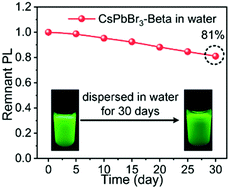
CsPbBr3 nanocrystals (NCs) with highly efficient narrow-band green emission are promising candidates in display applications. However, the poor stability of CsPbBr3 NCs is always a challenge for future development. Herein, we designed and prepared CsPbBr3 NCs encapsulated into zeolite Beta (denoted as CsPbBr3-Beta) composite via an optimized high temperature solid-state method, and the as-obtained power materials exhibited green emission peaking at 520 nm with a narrow full-width at half-maximum (FWHM) of 25 nm and a high photoluminescence quantum yield (∼61%). We further demonstrated the ultra-high luminescent stability of CsPbBr3-Beta composite by treating under a 150 °C treatment, soaking in water over 30 days, as well as applying in 450 nm light-emitting devices (LED) for 20 days. Ultimately, white-light-emitting devices (WLEDs) constructed by the green-emitting CsPbBr3-Beta composite and commercial blue chip and red K2SiF6:Mn4+ phosphor achieved a color gamut of 123.5% National Television System Committee standard (NTSC) and high luminous efficiency (LE = 95 lm W−1). This work highlights the encapsulation process and feasible solid-state reaction methodology to fabricate CsPbBr3 NCs confined in a microporous molecular sieve with high luminescent stability and performance, significantly expanding its great potential to be used in optoelectronic fields.
 Please wait while we load your content...


