


 PLATFORM UPDATE:


Lanthanide-doped nanoparticles in photovoltaics – more than just upconversion
 *abc
*abc
Abstract
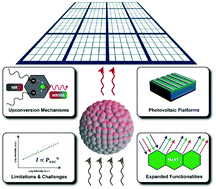
Development of photon conversion nanomaterials could principally leverage unutilized portions of the solar spectrum to address the increasing demand for renewable energy. However, improving photovoltaic performance using lanthanide-doped, spectral-converting nanomaterials remains a challenge. For photon upconversion, the most significant issues lie in their low quantum efficiencies and the need for high-power laser excitation. Despite these constraints, lanthanide-doped upconversion nanomaterials hold great promise to enhance the light-harvesting capacity and the conversion efficiency of existing solar cell modules. In this review, we highlight recent advances in developing high-efficiency upconversion nanoparticles for photovoltaic application. Special attention will be paid to fundamental energy transfer mechanisms, the survey of strategies for nanoparticle synthesis and surface modification, and various schemes of nanoparticle integration into photovoltaic devices. We also discuss future research directions and practical challenges in coupling upconversion nanomaterials with existing photovoltaic technologies.
- This article is part of the themed collections: Special issue in honour of Kees Hummelen, Journal of Materials Chemistry C Lunar New Year collection 2022 and 2021 Journal of Materials Chemistry C most popular articles
 Please wait while we load your content...


