


 PLATFORM UPDATE:

Defective transition metal hydroxide-based nanoagents with hypoxia relief for photothermal-enhanced photodynamic therapy†
 b
Hongping
Zhou
*a
b
Hongping
Zhou
*a
Abstract
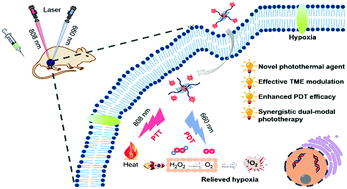
Recently, phototherapy has attracted much attention due to its negligible invasiveness, insignificant toxicity and excellent applicability. The construction of a newly proposed nanosystem with synergistic photothermal and photodynamic tumor-eliminating properties requires a delicate structure design. In this work, a novel therapeutic nanoplatform (denoted as BCS-Ce6) based on defective cobalt hydroxide nanosheets was developed, which realized hypoxia-relieved photothermal-enhanced photodynamic therapy against cancer. Defective cobalt hydroxide exhibited high photothermal conversion efficacy at the near-infrared region (49.49% at 808 nm) as well as enhanced catalase-like activity to produce oxygen and greatly boost the singlet oxygen generation by a photosensitizer, Ce6, realizing efficacious dual-modal phototherapy. In vivo and in vitro experiments revealed that BCS-Ce6 can almost completely extinguish implanted tumors in a mouse model and present satisfactory biocompatibility during the treatment. This work sets a new angle of preparing photothermal agents and constructing comprehensive therapeutic nanosystems with the ability to modulate the hypoxic tumor microenvironment for efficient cancer therapy.
 Please wait while we load your content...


