


 PLATFORM UPDATE:

Atomic defects in pothole-rich two-dimensional copper nanoplates triggering enhanced electrocatalytic selective nitrate-to-ammonia transformation†

Abstract
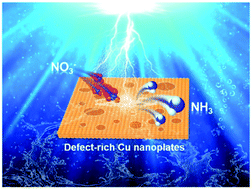
The development of efficient catalysts for electrocatalytic selective conversion of nitrate pollutants into valuable ammonia is a project of far-reaching importance. This work demonstrated the in situ electroreduction of pre-synthesized CuO nanoplates into defect-rich metallic Cu nanoplates and evaluated their electrocatalytic nitrate-to-ammonia activity. Concentrated atomic defects in the as-converted Cu nanoplates could favor the adsorption, enrichment and confinement of nitrate ions and pivotal reaction intermediates, selectively promoting eight-electron reduction (NH3 formation). Consequently, the resultant defect-rich Cu nanoplates exhibit a significant ammonia production rate of 781.25 μg h−1 mg−1, together with excellent nitrate conversion (93.26%), high ammonia selectivity (81.99%) and good electrocatalytic stability, superior to the defect-free Cu nanoplate counterpart. Isotope labelling experiments demonstrated that the source of ammonia was from nitrate. Both 1H NMR and colorimetric methods were used to quantify the ammonia yield.
 Please wait while we load your content...


