


 PLATFORM UPDATE:

Two-step assembly induced Fe0-anchored graphitic N-rich graphene with biactive centers for enhanced heterogeneous peroxymonosulfate activation†

Abstract
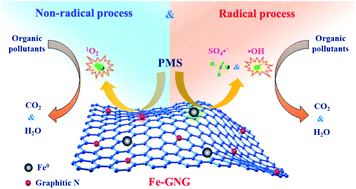
Herein, biactive centers of Fe0-anchored graphitic N-rich graphene (Fe-GNG) were constructed via coordination and hydrogen bonding assemblies followed by calcination. The obtained Fe-GNG exhibited excellent peroxymonosulfate (PMS) activation ability to degrade diverse organic pollutants, accompanied by very low activation energy. Electron paramagnetic resonance and quenching experiments indicated that ˙OH and 1O2 were the predominant reactive species responsible for organics degradation, and were generated from PMS activation mainly at Fe0 and graphitic N sites, respectively. The degradation process had wide pH (2.2–10.3) and temperature (5–45 °C) application ranges, and a high tolerance to common matrix species, which enabled application to natural water systems. Furthermore, the magnetic Fe-GNG catalyst exhibited high stability and reusability, still degrading over 90% organics after five runs. This work provides a feasible strategy to construct multiple active sites for PMS activation, and clarifies the synergistic effect of metal and carbonaceous materials in radical and nonradical activation processes.
 Please wait while we load your content...


