


 PLATFORM UPDATE:

Freestanding interlayers for Li–S batteries: design and synthesis of hierarchically porous N-doped C nanofibers comprising vanadium nitride quantum dots and MOF-derived hollow N-doped C nanocages†
 b
Jung Sang
Cho
*a
b
Jung Sang
Cho
*a
Abstract
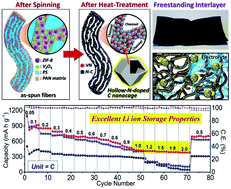
The introduction of a functional interlayer between the cathode and anode in lithium–sulfur battery (LSB) technology results in significant improvements in electrochemical performance. Here, we developed hierarchically structured porous, conductive, and multifunctional N-doped carbon (N-C) nanofibers comprising homogeneously dispersed vanadium nitride quantum dots and hollow N-C nanocages as functional interlayers for advanced LSBs. The freestanding interlayer contains well-developed long-range channels and numerous interconnected hollow N-C nanocages derived from the metal–organic framework. Furthermore, the presence of a N-C framework and vanadium nitride quantum dots measuring several nanometers improves the redox reaction kinetics and provides numerous chemisorption sites for the effective trapping and reuse of lithium polysulfide. As a result, the assembled Li–S cell employing the unique nanostructured freestanding interlayer exhibits superior rate capability and stable cycling performance (decay rate of 0.02% per cycle at 0.5C) considering the high sulfur content (80 wt%) and loading (ca. 4 mg cm−2) in the sulfur electrodes. Even with an ultra-high sulfur loading of 11.0 mg cm−2, the Li–S cell delivered a stable areal capacity of 5.0 mA h cm−2 after 100 charge–discharge cycles at 0.05C. Thus, the uniquely nanostructured interlayer shows high potential for the development of advanced LSBs utilizing pure sulfur electrodes with realistic battery parameters.
 Please wait while we load your content...


