


 PLATFORM UPDATE:


Halogenated sodium/lithium monocarba-closo-decaborates: syntheses, characterization, and solid-state ionic conductivity†

Abstract
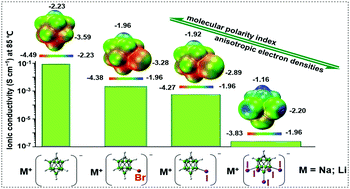
A series of halogenated monocarba-closo-decaborates, M[closo-1-CHB9H8-6-X] (M = Na, Li; X = Br, I) and M[closo-1-CHB9H4-6,7,8,9,10-I5] (M = Na, Li) have been synthesized for systematically investigating the influence of halogenation of the monocarba-closo-decaborates on the thermal stability, phase transition and ionic conductivity. The thermal stability of halogenated derivatives is lower than that of the corresponding parent compounds of M[closo-1-CHB9H9] (M = Na, Li) with a trend of M[closo-1-CHB9H8-6-Br] < M[closo-1-CHB9H8-6-I] < M[closo-1-CHB9H4-6,7,8,9,10-I5] (M = Na, Li). Both Na[closo-1-CHB9H8-6-Br] and Na[closo-1-CHB9H8-6-I] undergo a phase transition before decomposition, which occurred at a higher temperature than that of the parent compound Na[closo-1-CHB9H9]. In comparison to the parent compound, all halogenated derivatives show lower ionic conductivities with the trend of M[closo-1-CHB9H8-6-Br] > M[closo-1-CHB9H8-6-I] > M[closo-1-CHB9H4-6,7,8,9,10-I5] (M = Na, Li). The results are supported by the theoretical calculation results based on ESP, suggesting that the ionic conductivities of halogenated derivatives are mainly influenced by anisotropic electron densities.
 Please wait while we load your content...


