


 PLATFORM UPDATE:


Heterometallic {Dy III2Fe II2} grids with slow magnetic relaxation and spin crossover†
 a
and
Jinkui
Tang
*ab
a
and
Jinkui
Tang
*ab
Abstract
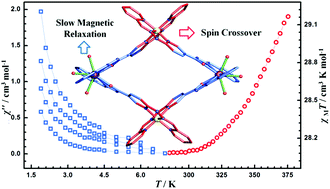
The assembly of molecules simultaneously exhibiting slow magnetic relaxation and spin crossover (SCO) behaviors at the molecular level is a fascinating challenge for chemists. The synthesis strategy of combining 3d and 4f ions in a molecule is a very promising route to a dual magnetic system. With this goal in mind, a series of mixed-metal structures, namely [Dy2Fe2(H2L)4(OH)6](NO3)4·12CH3OH·6H2O (1), [Dy2Fe2(H2L)4(OH)6]Cl4·2CH3OH·20H2O (2), [Dy2Fe2(H2L)4(OH)6]Cl4·4CH3OH·20H2O (3) and [Dy2Fe2(H2L)4(NO3)3CH3O](NO3)5(CF3SO3)·6CH3OH·H2O (4) containing a versatile Schiff-base ligand N′-((E)-pyridin-2-ylmethylene)-6-(2-((E)-pyridin-2-ylmethylene)hydrazinyl)nicotinohydrazide (H2L), have been synthesized and characterized. Alternating current (ac) susceptibility measurements reveal that complexes 1–4 exhibit a slow magnetic relaxation behavior. More importantly, complexes 2 and 3 exhibit one- and two-step SCO behaviors, respectively. To our knowledge, this is the first report on 3d–4f structures that exhibit the dual function of slow magnetic relaxation and SCO behaviors to date.
 Please wait while we load your content...


