


 PLATFORM UPDATE:

Propylene homopolymerization and copolymerization with ethylene by acenaphthene-based α-diimine nickel complexes to access EPR-like elastomers†

Abstract
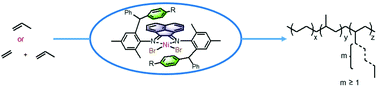
Benefiting from the unique chain walking characteristic of late transition metal complexes, branched EPR-like elastomers bearing distinct differences compared to traditional linear EPRs are reported herein. Firstly, a series of acenaphthene-based α-diimine nickel complexes were prepared and thoroughly characterized. The single crystal structures of rac-Ni4 and rac-Ni5 were further determined by X-ray crystallography, in which intra-ligand π–π interactions could be clearly observed. Being activated by Et3Al2Cl3, rac-Ni1–Ni5 are able to promote propylene homopolymerization and copolymerization with ethylene with high catalytic activities, affording EPR-like products with unique branched structures and sequences. Through regulating polymerization parameters (temperature, monomer feeding ratio, etc.) and ligand structures that play a pivotal role in governing the chain walking abilities of the precatalyst, obviously different polymer products were obtained respectively from propylene homopolymerization and ethylene/propylene copolymerization. The former case afforded products with predominant P units, whereas the latter case gave rise to copolymers with predominant E units. Furthermore, dramatic changes in the P and E unit contents as well as their sequences were observed along with the variation in polymerization temperature.
 Please wait while we load your content...


