


 PLATFORM UPDATE:


A general strategy for semiconductor quantum dot production†
 bc
and
Yong
Zhang
*ab
bc
and
Yong
Zhang
*ab
Abstract
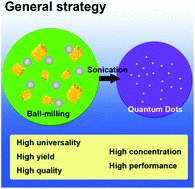
Mass production of semiconductor quantum dots (QDs) from bulk materials is highly desired but far from being satisfactory. Herein, we report a general strategy to mechanically tailor semiconductor bulk materials into QDs. Semiconductor bulk materials are routinely available via simple chemical precipitation. From their bulk materials, a variety of semiconductor (e.g., lead sulfide (PbS), cadmium sulfide (CdS), copper sulfide (CuS), ferrous sulfide (FeS), and zinc sulfide (ZnS)) QDs are successfully produced in high yields (>15 wt%). This is achieved by a combination of silica-assisted ball-milling and sonication-assisted solvent treatment. The as-produced QDs show intrinsic characteristics and outstanding water solubility (up to 5 mg mL−1), facilitating their practical applications. The QD dispersions present remarkable photoluminescence (PL) with exciton-dependence and nanosecond (ns)-scale lifetimes. The QDs-poly(methyl methacrylate) (PMMA) hybrid thin films demonstrate exciting solid-state fluorescence and exceptional nonlinear saturation absorption (NSA). Absolute modulation depths of up to 58% and saturation intensities down to 0.40 MW cm−2 were obtained. Our strategy could be applied to any semiconductor bulk materials and therefore paves the way for the construction of the complete library of semiconductor QDs.
 Please wait while we load your content...


