


 PLATFORM UPDATE:

Nanomolar level detection of metal ions by improving the monodispersity and stability of nitrogen-doped graphene quantum dots†
 *a
and
Banibrata
Maity
*a
*a
and
Banibrata
Maity
*a
Abstract
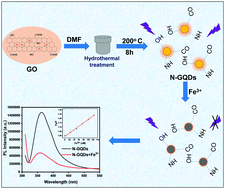
Heteroatom doping of graphene quantum dots (GQDs) leads to the modification of their intrinsic properties, and is used as a fluorescent sensor for metal ions sensing. Here, nitrogen-doped GQDs (N-GQDs) were synthesized using graphene oxide as a precursor in the presence of N,N′-dimethylformamide through a hydrothermal method. The particle size of N-GQDs was examined by a high-resolution transmission electron microscope (HRTEM) image. The surface functional groups and composition of N-GQDs were determined by X-ray photoelectron spectroscopy (XPS) and FTIR spectroscopic techniques. The introduction of nitrogen atoms in the framework of GQDs enhances its quantum yield, water solubility, and stability. The as-prepared nanoprobe has high sensitivity and selectivity for the label-free determination of Fe3+ ions. The values of the quantum yield, average lifetime, different photophysical parameters (such as radiative (kr) and non-radiative (knr) constants), rate of electron transfer (kET), and electron transfer efficiency (ΦEET) have been evaluated to confirm the dynamic quenching between the N-GQDs and Fe3+ ions. The prepared sensor showed high sensitivity with a very good limit of detection at the nanomolar range, i.e., 17 nM for Fe3+ ions, as compared to the other sensors. The prepared sensing probe was also used for the sensing of Fe3+ ions in iron supplementation, and it can be further used for different real sample detection. The synthesized fluorescent probe is very fast, inexpensive, and environmentally friendly.
 Please wait while we load your content...


