


 PLATFORM UPDATE:


Facile synthesis of Co(ii)-doped cobalt oxide nanostructures: their application in the sensitive determination of the prophylactic drug furazolidone†
 a
Shen-Ming
Chen
*a
and
a
Shen-Ming
Chen
*a
and
Abstract
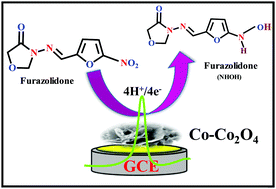
In this report, cobalt(II)-doped cobalt oxide (Co–Co2O4) rose-like nanostructures were synthesized via a facile one-step ultrasonication method. The as-prepared nano Co–Co2O4 was then utilized for the sensitive quantification of the prophylactic drug furazolidone (FUZ). Various physicochemical methods, including X-ray powder diffraction, high-resolution transmission electron microscopy, and X-ray photoelectron spectroscopy, were used to confirm the successful formation of the Co–Co2O4 nanostructures. The superior active surface area and larger pores of Co–Co2O4 enhance the electrocatalytic activity towards FUZ detection. The electrochemical performance of Co–Co2O4 towards FUZ was explored using the voltammetry method, with the obtained results suggesting that the proposed Co–Co2O4 sensor exhibits excellent catalytic activity towards FUZ. Under the optimized conditions, the sensor exhibits two wide linear ranges (0.05–285 μM; 285–1122.15 μM) with a low limit of detection (8 nM) and high sensitivity (2.349 μA μM−1 cm−2). Besides this, the proposed sensor exhibits high stability, reproducibility, and repeatability. Moreover, anti-interference experiments were carried out to explore the precise detection of FUZ in the presence of similar compounds.
 Please wait while we load your content...


