


 PLATFORM UPDATE:

Cationic poly-l-amino acid-enhanced selective hydrogen production based on formate decomposition with platinum nanoparticles dispersed by polyvinylpyrrolidone
 *ab
*ab
Abstract
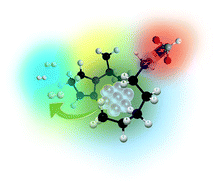
Formate is attracting attention as a hydrogen carrier because of its low toxicity and easy handling in aqueous solution. In order to utilize formic acid as a hydrogen carrier, a catalyst for efficiently and selectively decomposing formic acid into H2 in a low pH region is required. In this work, enhancement of selective H2 production from formate with platinum nanoparticles dispersed by polyvinylpyrrolidone (PVP) and cationic poly-L-amino acid, poly(L-lysine) (PLL), poly(L-histidine)(PLH) and poly(L-arginine)(PLR) (Pt-PVP/PLX; X = L, H or R) in a low pH region was attempted. By using all Pt-PVP/PLX or Pt-PVP for formate decomposition catalysts, the amount of H2 produced was maximized using an aqueous formate solution with a pH of 3.5 (close to a pKa of 3.75 of formic acid). The H2 production catalytic activity of Pt-PVP/PLX (X = L or H) improved compared with that of Pt-PVP in the low pH range (pH = 1.8). By using Pt-PVP/PLL, especially, the amount of H2 produced was improved to about 1.8 times compared to that of Pt-PVP under a pH = 1.8 condition. There was no difference in the electronic states of the platinum nanoparticles in Pt-PVP and Pt-PVP/PLL according to the extended X-ray absorption fine structure and X-ray absorption near edge structure spectra measurements. The amount of H2 produced tended to increase as the PLL content ratio in Pt-PVP/PLL increased and the protonated alkylammonium moiety of PLL in Pt-PVP/PLL attracted the dilute formate ions in the solution to platinum nanoparticles, and the catalytic activity for H2 production was improved under the low pH range.
 Please wait while we load your content...


