


 PLATFORM UPDATE:

The state of the art in plant lipidomics

Abstract
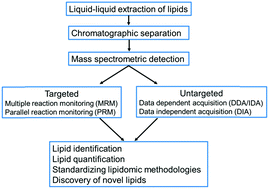
Lipids are a group of compounds with diverse structures that perform several important functions in plants. To unravel and better understand their in vivo functions, plant biologists have been using various lipidomic technologies including liquid-chromatography (LC)–mass spectrometry (MS). However, there are still significant challenges in LC-MS based plant lipidomics, which need to be addressed. In this review, we provide an overview of the key developments in LC-MS based lipidomic approaches to detect and identify plant lipids with emphasis on areas that can be further improved. Given that the cellular lipidome is estimated to contain hundreds of thousands of lipids,1,2 many of the lipid structures remain to be discovered. Furthermore, the plant lipidome is considered to be significantly more complex compared to that of mammals. Recent technical developments in mass spectrometry have made the detection of novel lipids possible; hence, approaches that can be used for plant lipid discovery are also discussed.
 Please wait while we load your content...

