


 PLATFORM UPDATE:


Efficient visible-light-driven hydrogen production by Zn–porphyrin based photocatalyst with engineered active donor–acceptor sites†
 *bd
and
Lingamallu
Giribabu
*bc
*bd
and
Lingamallu
Giribabu
*bc
Abstract
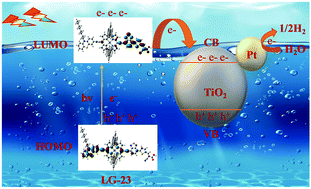
Here, we report a fine-tuned donor-π-acceptor concept based zinc-porphyrin-sensitized TiO2 photocatalyst for the application in photochemical hydrogen evolution. The newly designed system showed unprecedented photocatalytic activity. The molecular structure comprises of 3-ethynyl phenothiazine as a donor moiety, porphyrin as a π-spacer, and either 3-(4-(benzo[c][1,2,5]thiadiazol-4-yl)phenyl)-2-cyanoacrylic acid (LG-22) or 3-(4-(benzo[c][1,2,5]thiadiazol-4-yl)thiophene-2-yl)-2- cyanoacrylic acid (LG-23) as an acceptor attached at meso-position of the zinc-porphyrin. Superior hydrogen generation efficiency has been keenly observed over PCT-LG-23 in correspondence with PCT-LG-22 and that of Pt–TiO2 through visible light-induced photocatalytic water splitting. The effect of pH over photocatalytic hydrogen generation efficiency has been studied in the presence of triethanolamine (TEOA) which acts as a sacrificial electron donor (SED). LG-22 and LG-23 show H2 production yields of 8850.9 μmol h−1 and 9793.5 μmol h−1 at pH = 12 and pH = 3, respectively with a high turnover number (TON was 11801.2, 13058 for LG-22 and LG-23, respectively) under light irradiation with apparent quantum yields (AQY) of 7.20% and 7.96% for LG-22 and LG-23, respectively. The presence of thiophene and Benzo[1,2-b:4,5-b′]dithiophene (BDT) facilitated the extended π-conjugation, which gave rise to the excited state electronic properties and basicity of thiophene that enhanced the light absorption capacity of LG-23 in acidic conditions. Thus, this work provides a prime example of more efficient photonic conversion of an already existing, moderately active Zn porphyrin synthetic complex core encompassed precisely positioned functionalities of thiazine.
 Please wait while we load your content...


