


 PLATFORM UPDATE:


A new computational strategy to calculate the edge energy of a relaxed step. Calcite (CaCO3) as a case study†
 *abc
and
D.
Aquilano
a
*abc
and
D.
Aquilano
a
Abstract
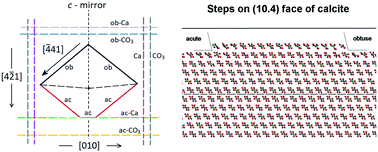
Determination of the step edge energy, ρ (J m−1), is a very difficult task. For this reason, very few theoretical estimates of the edge energies of crystalline materials exist. Nowadays, ρ is calculated using a method that requires geometry optimization of many systems. In this paper, we propose a new computational approach for calculating ρ, based on the construction of a 2D periodic (hkl) slab, on which a [uvw] step delimited by two relaxed edges (acute and obtuse) is generated; the method has been designed both for empirical and quantum-mechanical calculations. At variance with a previous computational method, our strategy requires the geometry optimization of only a system; then it results to be more accurate and less expensive from a computational point of view. We applied this new methodology to the study of the [![[4 with combining macron]](https://www.rsc.org/images/entities/char_0034_0304.gif) 41], [4
41], [4![[2 with combining macron]](https://www.rsc.org/images/entities/char_0032_0304.gif) 1] and [010] steps lying on the flat (10.4) face of calcite. The structure and energy of the different [uvw] edges were determined. We calculated, as the most stable step, the acute [41] edge (ρ = 5.04 × 10⁻¹⁰ J m−1), followed by the Ca-terminated acute-[010] (5.39 × 10⁻¹⁰ J m−1) and Ca-terminated [41] (9.77 × 10⁻¹⁰ J m−1). Finally, by using these edge energies, we draw the equilibrium shape of a relaxed 2D nucleus lying on the (10.4) face.
1] and [010] steps lying on the flat (10.4) face of calcite. The structure and energy of the different [uvw] edges were determined. We calculated, as the most stable step, the acute [41] edge (ρ = 5.04 × 10⁻¹⁰ J m−1), followed by the Ca-terminated acute-[010] (5.39 × 10⁻¹⁰ J m−1) and Ca-terminated [41] (9.77 × 10⁻¹⁰ J m−1). Finally, by using these edge energies, we draw the equilibrium shape of a relaxed 2D nucleus lying on the (10.4) face.
 Please wait while we load your content...


