


 PLATFORM UPDATE:

A paper-based chemiluminescence detection device based on S,N-doped carbon quantum dots for the selective and highly sensitive recognition of bendiocarb†
 *a
and
*a
and
Abstract
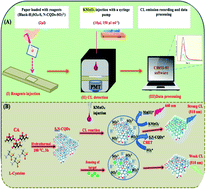
Bendiocarb, a type of carbamate pesticide, plays a crucial role in controlling a wide range of pests. Due to its harmful impact on humans and the environment, the need for inexpensive, portable, efficient and easy-to-use analytical devices has become essential. In this study, an environmentally friendly paper-based analytical device (PAD) with a chemiluminescence (CL) sensing platform was investigated and characterized for the facile, reliable and sensitive detection of the bendiocarb pesticide. It is based on the enhancing effect of SO32− on the CL reaction of sulfur, nitrogen-doped carbon quantum dots (S,N-CQDs)–KMnO4 in acidic media. According to the experiments, S,N-CQDs and SO32− both are oxidized by KMnO4 to generate (S,N-CQDs*) and (SO2*) in their excited states, emitting at 510 nm. This indicates that an energy transfer process is taking place from SO2* to S,N-CQDs, resulting in a remarkably intensified CL emission. Interestingly, another emission was also observed around 660 nm contributing to about 20 to 25% of the total CL emission. This emission is related to the Mn2+* species produced by reducing MnO4−. The established multi-emission CL system was tested for analytical applications. Under optimal experimental conditions, a good linear relationship was observed between the bendiocarb concentration and the CL intensity of the established CL system. The linear detection range was 0.1–10 μg mL−1, with a limit of detection (LOD) of 0.02 μg mL−1. Finally, the method was successfully applied for the measurements of bendiocarb in water and juice samples. The obtained recovery values (97.5–105.5) verified the suitable accuracy of the results.
 Please wait while we load your content...


