


Copper(ii) ketimides in sp3 C–H amination†
 a
Abolghasem (Gus)
Bakhoda,
‡a
Nour L.
Khachemoune,
a
Jeffery A.
Bertke
a
and
Timothy H.
Warren
§*a
a
Abolghasem (Gus)
Bakhoda,
‡a
Nour L.
Khachemoune,
a
Jeffery A.
Bertke
a
and
Timothy H.
Warren
§*a
Abstract
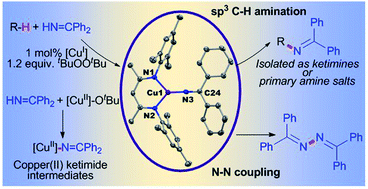
Commercially available benzophenone imine (HN![[double bond, length as m-dash]](https://www.rsc.org/images/entities/char_e001.gif) CPh2) reacts with β-diketiminato copper(II) tert-butoxide complexes [CuII]–OtBu to form isolable copper(II) ketimides [CuII]–NCPh2. Structural characterization of the three coordinate copper(II) ketimide [Me3NN]Cu–NCPh2 reveals a short Cu-Nketimide distance (1.700(2) Å) with a nearly linear Cu–N–C linkage (178.9(2)°). Copper(II) ketimides [CuII]–NCPh2 readily capture alkyl radicals R˙ (PhCH(˙)Me and Cy˙) to form the corresponding R–NCPh2 products in a process that competes with N–N coupling of copper(II) ketimides [CuII]–NCPh2 to form the azine Ph2CN–NCPh2. Copper(II) ketimides [CuII]–NCAr2 serve as intermediates in catalytic sp3 C–H amination of substrates R–H with ketimines HNCAr2 and tBuOOtBu as oxidant to form N-alkyl ketimines R–NCAr2. This protocol enables the use of unactivated sp3 C–H bonds to give R–NCAr2 products easily converted to primary amines R–NH2via simple acidic deprotection.
CPh2) reacts with β-diketiminato copper(II) tert-butoxide complexes [CuII]–OtBu to form isolable copper(II) ketimides [CuII]–NCPh2. Structural characterization of the three coordinate copper(II) ketimide [Me3NN]Cu–NCPh2 reveals a short Cu-Nketimide distance (1.700(2) Å) with a nearly linear Cu–N–C linkage (178.9(2)°). Copper(II) ketimides [CuII]–NCPh2 readily capture alkyl radicals R˙ (PhCH(˙)Me and Cy˙) to form the corresponding R–NCPh2 products in a process that competes with N–N coupling of copper(II) ketimides [CuII]–NCPh2 to form the azine Ph2CN–NCPh2. Copper(II) ketimides [CuII]–NCAr2 serve as intermediates in catalytic sp3 C–H amination of substrates R–H with ketimines HNCAr2 and tBuOOtBu as oxidant to form N-alkyl ketimines R–NCAr2. This protocol enables the use of unactivated sp3 C–H bonds to give R–NCAr2 products easily converted to primary amines R–NH2via simple acidic deprotection.
 Please wait while we load your content...


