


In vitro and in silico molecular docking studies of Rheum emodi-derived diamagnetic SnO2 nanoparticles and their cytotoxic effects against breast cancer

Abstract
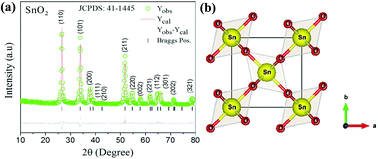
Green-route-bioengineered nanoparticles have received significant attention for diagnosis and treatment of cancer in the medical technology era due to their non-toxic nature, cost-friendliness, and energy efficiency. Interestingly, tin oxide nanoparticles (SnO2 NPs) were synthesized from the root extract of Himalayan herb Rheum emodi by a cost-effective and environmentally friendly method. Structural analysis revealed that biosynthesized SnO2 NPs show a tetragonal crystal symmetry with the space group P4/2mnm as confirmed by the Rietveld refinement method. By transmission electron microscopy (TEM), the average particle diameter was established as ∼40 nm with a spherical shape. Furthermore, by Fourier transform infrared (FTIR) spectroscopy analysis, it was revealed that metabolites (hydroxyanthraquinones) present in Rheum emodi root extracts act as capping, reducing and stabilizing agents aiding in the synthesis of SnO2 NPs. Amongst the major metabolites aiding the anticancer activity, aloe-emodin, archin (emodin), chrysophanic acid (chrysophanol) and parietin (physcion) are established anti-cancer agents. It is noteworthy that the Rheum emodi root extract-derived SnO2 NPs deployed the diamagnetic character in a room-temperature magnetic characterization environment of a vibrating sample magnetometer (VSM). It was observed that the room-temperature photoluminescence spectra revealed a rich violet emission band of wavelength ∼419 nm. In addition, the anticancer potential of Rheum emodi root extract-derived SnO2 NPs was investigated against the breast cancer cell line MDA-MB-231 at different concentrations. Finally, we docked hydroxyanthraquinones (aloe-emodin, archin, chrysophanic acid and parietin) with anti-cancer proteins (estrogen receptor alpha, epidermal growth factor receptor, N-myristol transferase, mammalian target of rapamycin, vascular endothelial growth receptor-2 and progesterone receptor) to confirm the anticancer potential of Rheum emodi.
 Please wait while we load your content...


