


 PLATFORM UPDATE:

Significantly enhanced electron transport of a nonfullerene acceptor in a blend film with a high hole mobility polymer of high molecular weight: thick-film nonfullerene polymer solar cells showing a high fill factor†
 a
Junwu
Chen
*ac
a
Junwu
Chen
*ac
Abstract
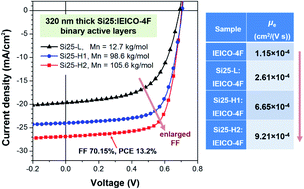
Overcoming fill factor (FF) decay in thick fullerene active layers has been demonstrated with high hole mobility (μh) polymers. However, this issue remains a challenge for thick active layers with nonfullerene acceptors. Here we demonstrate a high FF and highly efficient nonfullerene based thick active layer with a high μh polymer as the donor. Its relatively balanced hole and electron transport with a μh/μe ratio of 4.42 in a 320 nm thick blend film is realized by the high molecular weight polymer induced higher electron mobility (μe approaching 1 × 10⁻³ cm2 (V s)−1) for the blend film. Relative to the pristine IEICO-4F nonfullerene film, 8 times increased μe for the blend film corresponds to closer interdigitation of the IEICO-4F lamella and a higher order face-on orientation of the in-plane (200) peak of IEICO-4F molecules, which are very helpful for electron transport. As a result, solar cells with 320 nm thick binary nonfullerene active layers show an outstanding FF of over 70% and a power conversion efficiency of 13.2%, a breakthrough for high μh polymers as the donor. Our results suggest that high μh polymer donors are promising candidates for nonfullerene based polymer solar cells.
 Please wait while we load your content...


