


 PLATFORM UPDATE:


A stable LnMOF as a highly efficient and selective luminescent sensor for detecting malachite green in water and real samples†
 ac
and
Shao-Wu
Du
*b
ac
and
Shao-Wu
Du
*b
Abstract
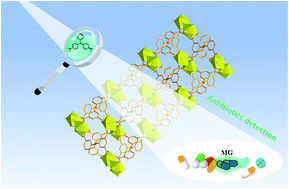
A series of isostructural 3D lanthanide metal–organic frameworks (LnMOFs), with the formula n(H3O)[Ln(L)(H2O)]n·nH2O (Ln = Gd 1, Eu 2 and Tb 3, H4L = 3,5,3′,5′-oxytetrabenzoic acid), have been successfully synthesized by solvothermal reactions. Single-crystal X-ray diffraction analysis reveals that 1–3 are constructed from wave-like Ln–carboxylate chains which are further connected by the ligands to form 3D channel-type frameworks. Further experiments suggest that 3 is thermally stable up to 322 °C and exhibits outstanding chemical stability in aqueous solutions with the pH ranging from 3 to 11. Significantly, 3 can be utilized for the first time to detect malachite green (a synthetic antibiotic to cure saprolegniasis) in aqueous media even in the presence of other interfering antibiotics, with a high sensitivity (Ksv = 8.33 × 10⁴ M−1), low detection limit (DL = 0.25 μM) and good recyclability. On a more practical note, we found that the luminescence intensity of 3 showed almost no response to pH changes (pH 3–11), allowing steady sensing in real samples such as river water, simulated human serum and urine with satisfactory recoveries and RSD.
 Please wait while we load your content...


