


 PLATFORM UPDATE:

Highly stretchable, self-healing, and 3D printing prefabricatable hydrophobic association hydrogels with the assistance of electrostatic interaction†
 a
Shaojun
Chen
*a
a
Shaojun
Chen
*a
Abstract
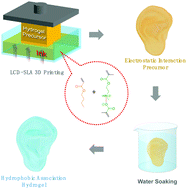
Outstanding mechanical performances and designable architectures are essential for hydrogels when applied as structural materials. In this work, a series of physically cross-linked hydrogels were prepared by copolymerization of a hydrophobic monomer of butyl acrylate and an ampholytic cross-linker of 2-(dimethylamino)ethyl methacrylate and methacrylic acid, followed by soaking in water. The ampholytic cross-linker supported the 3D-printing fabrication of hydrogel precursors, and further hydrated to induce hydrophobic association and caused the transformation from hydrogel precursors to hydrogels. These hydrogels with a water content of 10.4–57.0 wt% possessed excellent mechanical properties, with a tensile strength, elongation at break, and Young's modulus of 61.0–103.4 kPa, 1150–1560%, and 42.7–125.7 kPa, respectively, and meanwhile exhibited fast and high autonomous self-healing ability. This work developed a facile strategy to prepare self-healing hydrophobic association hydrogels besides emulsion polymerization, and offer new ways to construct physically cross-linked hydrogels with designable architectures.
 Please wait while we load your content...


