


 PLATFORM UPDATE:

Carboxylate, nitrate, sulfonate, and phosphate catalysts for living radical polymerization via oxygen–iodine halogen bonding catalysis†

Abstract
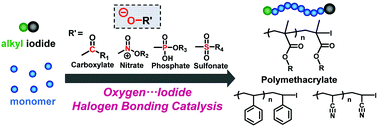
Four families of oxyanions, i.e., carboxylate, nitrate, phosphate, and sulfonate, were studied as novel catalysts in living (or reversible deactivation) radical polymerization via oxygen–iodine halogen bonding catalysis. Oxyanions with sodium and tetraalkylammonium counter-cations exhibited good catalytic activities and high solubilities in hydrophilic and hydrophobic monomers. These oxyanion catalysts were amenable for methyl methacrylate, functional methacrylates, styrene, and acrylonitrile, and also afforded block copolymers with low dispersities. The catalytic activities of the oxyanions were also theoretically studied using density functional theory (DFT) calculation. The studied four families of oxyanions are abundant in natural and synthetic compounds. Non-toxic natural carboxylates were successfully used to synthesize well-defined biocompatible polymers. The low cost, low toxicity, and accessibility for a range of polymer designs are attractive features for practical use.
 Please wait while we load your content...


