


 PLATFORM UPDATE:

Effects of dielectric screening on the excitonic and critical points properties of WS2/MoS2 heterostructures†

Abstract
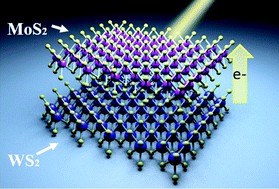
Vertical van der Waals heterostructures have aroused great attention for their promising application in next-generation nanoelectronic and optoelectronic devices. The dielectric screening effect plays a key role in the properties of two-dimensional (2D) heterostructures. Here, we studied the dielectric screening effects on the excitonic properties and critical points (CPs) of the WS2/MoS2 heterostructure using spectroscopic ellipsometry (SE). Owing to the type-II band alignment of the WS2/MoS2 heterostructure, charged carriers spatially separated and created an interlayer exciton, and the transition energy and binding energy have been accurately found to be 1.58 ± 0.050 eV and 431.39 ± 127.818 meV by SE, respectively. We found that stacking the WS2/MoS2 vertical heterostructure increases the effective dielectric screening compared with the monolayer counterparts. The increased effective dielectric screening in the WS2/MoS2 heterostructure weakens the long-range Coulomb force between electrons and holes. Consequently, the quasi-particle band gap and the exciton binding energies are reduced, and because of the orbital overlap, more CPs are produced in the WS2/MoS2 heterostructure in the high photon energy range. Our results not only shed light on the interpretation of recent first-principles studies, but also provide important physical support for improving the performance of heterostructure-based optoelectronic devices with tunable functionalities.
 Please wait while we load your content...


