


 PLATFORM UPDATE:


A reliable alternative approach for the ultra-sensitive detection of l-glutathione with wet chemically synthesized Co3O4-doped SnO2 nanoparticles decorated on a glassy carbon electrode
 *a
M. M.
Alam
*b
and
*a
M. M.
Alam
*b
and
Abstract
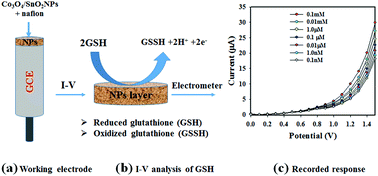
In this study, an electrochemical sensor was fabricated for the non-enzymatic detection of L-glutathione via an electrochemical approach using wet chemically prepared Co3O4-doped SnO2 nanoparticles (NPs) decorated on a glassy carbon electrode (GCE). X-ray photoelectron spectroscopy (XPS), X-ray powder diffraction (XRD), field-emission scanning electron microscopy (FESEM), energy-dispersive X-ray spectroscopy (EDS), UV/visible spectroscopy, Brunauer–Emmett–Teller (BET) analysis, and Fourier-transform infrared (FTIR) spectroscopy were carried out for the detailed characterization of the synthesized NPs. The Co3O4-doped SnO2 NPs were deposited onto a GCE, resulting in the proposed L-glutathione sensor, and it was calibrated via plotting current versus the concentration of L-glutathione. The sensor sensitivity (20.9873 μA μM−1 cm−2) is obtained from the slope of the calibration plot, considering the surface area (0.0316 cm2) of active NPs on the GCE. In the non-enzymatic detection of L-glutathione, the assembled sensor exhibits a broad linear dynamic range (0.1 mM–0.1 nM), a limit of detection (LOD) of 93.65 ± 4.68 pM, a limit of quantification (LOQ) of 936.5 ± 46.8 pM, appreciable reproducibility, outstanding working-electrode stability, and high efficiency. It is able to detect L-glutathione in real biological samples efficiently. Thus, this is an alternative approach for the reliable detection of chemicals and biochemicals in the environmental and healthcare sectors.
 Please wait while we load your content...


