


 PLATFORM UPDATE:

Formation of metal-radical species upon reduction of late transition metal complexes with heteroleptic ligands: an experimental and theoretical study†

Abstract
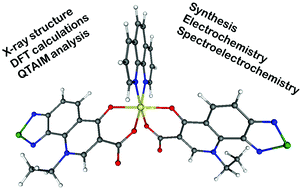
A series of three new metal complexes with selenadiazoloquinolones, known as broad spectrum antibiotics in clinical praxis, namely [Co(E4h)2(phen)]·8H2O (1), [Ni(E4h)2(phen)]·8H2O (2) and [Cu(E4h)(phen)Cl]·5H2O (3), have been synthesized and fully characterized by analytical methods, ESI mass spectrometry, single crystal X-ray crystallography, cyclic voltammetry (CV), and in situ EPR/UV-vis-NIR spectroelectrochemistry supported by theoretical calculations. For 1 and 2 two-electron transfer leads to the formation of a paramagnetic dianion with the spin density localized on the two weakly interacting selenadiazole moieties. For 3 the first reduction step represents a reduction process on the central atom, while the second reversible reduction step occurs on the selenadiazole moiety. The formation of a radical anion of selenadiazoloquinolone upon cathodic reduction was confirmed both experimentally and by DFT calculations. The optimized geometries were compared with the geometric parameters resulting from single crystal X-ray diffraction data, and the bonding in 1–3 was inspected via analysis of bond critical points (BCP) under the formalism of Bader's quantum theory of atoms in molecules (QTAIM).
 Please wait while we load your content...


