


 PLATFORM UPDATE:

tert-Butyl thiol and pyridine ligand co-protected 50-nuclei clusters: the effect of pyridines on Ag–SR bonds†
 *a
and
Xing
Lu
a
*a
and
Xing
Lu
a
Abstract
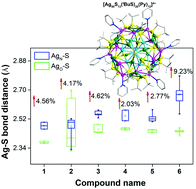
Constructing silver(I)–thiolate clusters from simple building blocks usually involves elusive self-assembly processes and remains a long-standing challenge. In this work, we report 6 silver(I)–thiolate clusters protected by pyridines, namely, [Ag3(tBuS)2(Py)(NO3)]n (Py = pyridine) (1), [Ag10(tBuS)6(Py)6(CF3CO2)4]·3Py (2), [Ag12(iPrS)6(Py)8(NO3)6]·2H2O (3), Ag12(iPrS)6(Py)8(CF3CO2)6 (4), Ag12(iPrS)6(4-ap)6(NO3)6 (4-ap = 4-aminopyridine) (5), and [Ag50S13(tBuS)20(Py)12]·4BF4·4Py·4CH3OH·2H2O (6). Single-crystal X-ray crystallography analysis reveals that six clusters are constructed by four types of structural blocks, including the PyAg(tBuS)2 monomer, Py2Ag2(tBuS)2 dimer, Py3Ag3(tBuS)3 trimer and (4-ap)6Ag6(iPrS)6 hexamer. Notably, cluster 6 consists of a rhombic dodecahedron S@Ag14 kernel with 12 interstitial S2− atoms encapsulated by 8 μ4-tBuS− ligands, as well as six unique butterfly-like (Py)2Ag6(tBuS)2 staple motifs composed of a Py2Ag2(tBuS)2 dimer and four silver ions. Moreover, it is found that pyridine ligands have important influence on the construction of silver thiolate clusters and their Ag–SR bond lengths.
 Please wait while we load your content...


