


 PLATFORM UPDATE:

Enhanced production of H2 under visible light via co-deposited Pt and Ir species on g-C3N4†
 a
and
a
and
Abstract
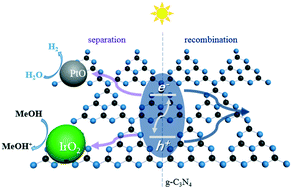
Graphitic carbon nitride (g-C3N4) is a promising metal-free semiconductor photocatalyst for H2 evolution. In this work, g-C3N4 has been modified with IrO2via a thermal reaction, followed by photochemical deposition of PtO. After co-catalyst loading, g-C3N4 had no change in crystal structure, but its dimension within the layers was reduced, together with a blue shift in light absorption and emission. In a methanol aqueous solution under visible light, g-C3N4 was nearly not active for H2 evolution, but modified g-C3N4 was quite active. With IrO2/g-C3N4, Pt/g-C3N4, and Pt/IrO2/g-C3N4, the rates of H2 production were measured to be 10.6, 21.4, and 41.2 μmol min−1 g−1, respectively. Moreover, the reaction rate was greatly dependent on co-catalyst loading in modified g-C3N4. The Pt/IrO2/g-C3N4 sample was more active than NiS and MoS2 loaded g-C3N4, by factors of approximately 12 and 24, respectively. (Photo)electrochemical measurement revealed that Pt species catalyzed proton reduction, while Ir species catalyzed water oxidation. A plausible mechanism is proposed, involving synergism between PtO-mediated electron transfer and IrO2-mediated hole transfer.
 Please wait while we load your content...


