



Hydrothermal synthesis of two 2D uranyl coordination polymers: structure, luminescence, and photocatalytic degradation of rhodamine B†
 *a
*a
Abstract
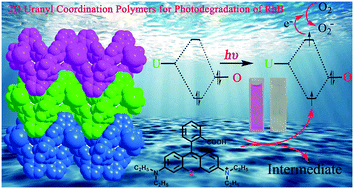
Two novel two-dimensional (2D) uranyl coordination polymers, namely [(UO2)(bpda)]n (1) and [(UO2)(bpda)(nmp)]n (2) (bpda = [1,1′-biphenyl]-2,4′-dicarboxylic acid, nmp = N-methyl pyrrolidone), were synthesized by a hydrothermal method. Single-crystal structural analyses reveal that both polymers were constructed by the packing of 2D uranyl coordination networks via supramolecular interactions. The 2D network of 1 was constructed from distorted pentagonal bipyramid uranyl chains, while which was dual uranyl pentagonal bipyramid for 2. Topological simplification obtained 2D topological symbol of {42·84}{46} for 1 and 4-c {44·62} for 2. Both polymers exhibit the emblematic charge-transfer green emission of uranyl-bearing complexes. The UV-vis absorption spectra reveal distinct light absorption both on the ultraviolet and visible regions for 1 and 2. Excellent activities of the photocatalytic degradation of rhodamine B (RhB) in aqueous solutions using polymers 1 and 2 were studied, 84.0% of the RhB was degraded in only 30 min under the photocatalysis of 1 and almost all of the RhB (99.7%) was degraded in 90 min by the photocatalysis of 2. These two new 2D uranyl coordination polymers represented effective RhB photocatalytic degradation materials in aqueous solution.
 Please wait while we load your content...


