



A red-emissive D–A–D type fluorescent probe for lysosomal pH imaging†

Abstract
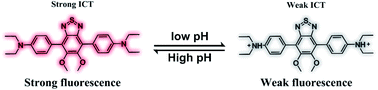
Visual detection of pH changes in lysosomes is critical because lysosomes not only play an important role in diverse cellular functions but also are closely related to various physiological and pathological processes. Herein, we disclose a donor–acceptor–donor (D–A–D) type fluorescent probe DBTD for detecting pH fluctuation in lysosomes. DBTD was rationally designed by using benzothiadiazole as the electron acceptor and N,N-diethylamino groups as the electron donor. Owing to its unique D–A–D structure, DBTD displayed a red-emission centered at 614 nm. It showed a sensitive and a linear response to pH from 4.5 to 5.2 with a pKa of 5.0, which is very suitable for lysosomal pH imaging. The response was based on the intramolecular charge transfer (ICT) effect owing to the protonation of the diethylamino group. Furthermore, DBTD could accurately monitor lysosomal pH variations in SGC-7901 cells. More importantly, it was able to image the pH change in lysosomes during the autophagy process successfully, suggesting the great potential of DBTD acting as a powerful tool for monitoring lysosomal pH-related biological processes.
 Please wait while we load your content...


