


 PLATFORM UPDATE:

Non-halogenated-solvent-processed highly efficient organic solar cells with a record open circuit voltage enabled by noncovalently locked novel polymer donors†

Abstract
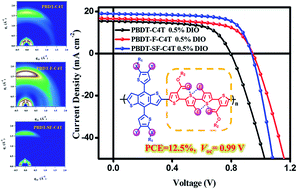
The relatively low open circuit voltage (Voc) of organic solar cells (OSCs) with narrow and ultra-narrow bandgap fused-ring electron acceptors limits further improvement of the OSCs. Simply down-shifting the highest occupied molecular orbital (HOMO) levels of the donors always results in the trade-off between the Voc and short circuit current (Jsc). In this work, we reported three novel noncovalently locked polymer donors based on different side-chain-modified benzodithiophene (BDT) units alternately copolymerized with an electron-deficient 3,3′-dicarboxylate-substituted difluorotetrathiophene building block for efficient OSCs. Due to the existence of the electron-affinity moiety, deep HOMO levels are obtained for these copolymer donors, enabling the highest recorded Voc of 0.99 V when blended with the IT-4F acceptor. Meanwhile, intramolecular noncovalent interactions in these copolymers favor a preferential face-on orientation. Efficient charge transport and exciton dissociation under a low driving force are observed in these novel polymer donors. Consequently, the device processed from a non-halogenated solvent shows a high efficiency of 12.5% with simultaneously high Voc and Jsc, which is one of the highest performances of non-halogenated-solvent-processed OSCs to date. These results demonstrate that the synergistic effect of the energy band structure and molecular geometry can provide an effective molecular design strategy for high performance OSCs.
 Please wait while we load your content...


