


 PLATFORM UPDATE:

Versatile cross-linked fatty acid-based polycarbonate networks obtained by thiol–ene coupling reaction

Abstract
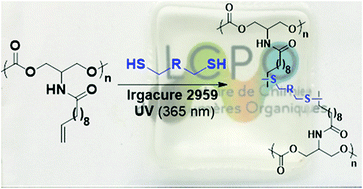
Bio-sourced polycarbonate networks have been synthesized from an alkene-functional fatty-acid based polycarbonate precursor. Cross-linked networks were created using the radical thiol–ene coupling reaction. The resulting polycarbonate materials exhibited versatile properties either influenced by the structure of the cross-linker or the cross-linker/olefin unit ratio. Indeed, the storage modulus above the glass transition temperature could be modulated from 0.9 to 8.9 MPa only by changing the type of cross-linker, i.e. 1,9-nonanedithiol vs. 1,4-benzenedimethanethiol. The cross-linker/olefin unit ratio was also shown to largely impact the polycarbonate networks properties. An elongation at break of nearly 200% was reached when a low cross-linker/olefin ratio was applied. Moreover, functional polycarbonate networks bearing pendant thiol groups were obtained when an excess of dithiol was used with respect to olefin groups.
 Please wait while we load your content...


