


 PLATFORM UPDATE:


Synthesis of well-defined glycopolymers with highly ordered sugar units in the side chain via combining CuAAC reaction and ROMP: lectin interaction study in homo- and hetero-glycopolymers†
 *abc
*abc
Abstract
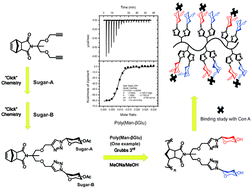
The heterogeneity of natural oligosaccharides containing various sugar units exists widely in molecular recognition, which can be utilized in enhancing the affinity and selectivity toward a specific receptor, thus the design of novel heterogeneous glycopolymers with different sugar motifs is of critical importance in the glycopolymer field. To investigate the significance of glycoheterogeneity in carbohydrate–protein binding, a series of well-defined homo-, hetero-glycopolymers and block, random glycopolymers with highly ordered sugar units in the side chain has been prepared by the combination of CuAAC reaction and ring-opening metathesis polymerization (ROMP). Isothermal titration calorimetry (ITC) measurements of the obtained glycopolymers with concanavalin A (Con A) as the model receptor indicated that the heteroglycopolymers, poly(Man-βGlu) and poly(Man-βGal) bearing both α-mannose and nonbinding β-glucose or β-galactose units, exhibit an approximately or more than 5-fold increase in their binding affinities to concanavalin A (Con A) as compared to monoglycopolymer poly(Man-Alkyne) and an over 1000-fold increase comparable to monosaccharide, methyl-α-mannose. The results revealed in this study further confirmed that heteroglycopolymers with non-binding sugar units present better specificity toward Con A than do monoglycopolymers with other functional groups in the side chain due to synergistic effects. As expected, both homoglycopolymers, poly(Man-Man) and poly(αGlu-αGlu) have strong binding activities towards Con A (Ka = 13.90 × 10⁶ M−1, Ka = 9.52 × 10⁶ M−1, respectively) due to multivalent binding and/or carbohydrate cluster effects. More intriguingly, the heteroglycopolymer, poly(Man-αGlu), exhibits near binding affinities to Con A in comparison with poly(Man-Man) supported by synergistic effects or an interplay where αGlu residues are added as weaker second binding units.
 Please wait while we load your content...


