


 PLATFORM UPDATE:

Iron-catalysed atom transfer radical polyaddition for the synthesis and modification of novel aliphatic polyesters displaying lower critical solution temperature and pH-dependent release behaviors†

Abstract
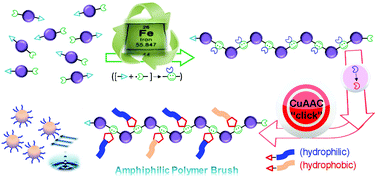
In this study we performed atom transfer radical polyadditions (ATRPAs) of the inimer 4-vinylbenzyl 2-bromo-2-phenylacetate (VBBPA), catalysed by environmentally friendly FeX3/triphenylphosphine (TPP) complexes in the absence of a reducing agent. Interestingly, we obtained linear-type PVBBPA polyesters of high molecular weight (MW) (Mw = ca. 27 000; Mw/Mn (Đ) = 1.50). UV–Vis spectroscopy revealed that reduction of the FeIII complex to an FeII complex was mediated by the VBBPA inimer, such that we could regard the mechanism as a generation of activators by inimer addition (GAIMA) ATRPA. In the presence of reducing agents, Fe0 and proanthocyanidins (PC), the chain branching reaction occurred at 70 °C, possibly because of insufficient deactivation from the deactivator to the benzylic radical (PhCH2˙) at the polymer backbone. At a moderate reaction temperature and in the presence of a moderate amount of Fe0, a high-MW PVBBPA polyester was obtained (Mw = ca. 40 000; Đ = 2.40). The PVBBPAs were then subjected to successive quantitative azidation and copper(I)-catalysed azide/alkyne cycloaddition (CuAAC) click reactions to obtain amphiphilic polymer brushes (APBs). By clicking different ratios of oligo(ethylene glycol)n (OEGn–![[triple bond, length as m-dash]](https://www.rsc.org/images/entities/char_e002.gif) ; n = 4, 7, 12) and 1-octyne (Oct), we observed reversible cloud points in the approximate range of 40–65 °C for the (OEG7/Oct)- and (OEG12/Oct)-grafted APBs; in contrast, only aggregation occurred for the (OEG4/Oct)-grafted APBs. The sizes of the micellized APBs were in the approximate range of 50–90 nm. We examined the drug release behavior of these APBs toward rhodamine B, as a model compound. The release profiles revealed high degrees of release (ca. 70–80%) in acidic environments, but they were poor (<10%) in neutral solutions, suggesting pH-sensitive behavior that resulted from the triazole units positioned along the polymer backbone.
; n = 4, 7, 12) and 1-octyne (Oct), we observed reversible cloud points in the approximate range of 40–65 °C for the (OEG7/Oct)- and (OEG12/Oct)-grafted APBs; in contrast, only aggregation occurred for the (OEG4/Oct)-grafted APBs. The sizes of the micellized APBs were in the approximate range of 50–90 nm. We examined the drug release behavior of these APBs toward rhodamine B, as a model compound. The release profiles revealed high degrees of release (ca. 70–80%) in acidic environments, but they were poor (<10%) in neutral solutions, suggesting pH-sensitive behavior that resulted from the triazole units positioned along the polymer backbone.
 Please wait while we load your content...


