


 PLATFORM UPDATE:


Simple hydrothermal synthesis of defective CeMoSe2 dendrites as an effective electrocatalyst for the electrochemical sensing of 4-nitrophenol in water samples†

Abstract
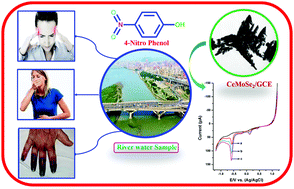
This work reports the fabrication of a highly selective and novel electrocatalyst for electrochemical sensing applications. To this aim, CeMoSe2 dendrites were synthesized via hydrothermal synthesis and characterized by using various analytical techniques such as X-ray diffraction (XRD), Raman spectroscopy, field emission scanning electron microscopy (FE-SEM), energy dispersive X-ray (EDX) spectroscopy, transmission electron microscopy (TEM) and X-ray photoelectric spectroscopy (XPS). Further, the conductivity of the as-prepared CeMoSe2 dendritic structure was studied by electrochemical impedance spectroscopy (EIS). The higher conductivity of the CeMoSe2 dendrites made them essential for the electrochemical detection of 4-nitrophenol (4-NP) using cyclic voltammetry (CV) and linear sweep voltammetry (LSV). Electrochemical studies proved that the CeMoSe2 dendrite modified electrode (GCE) shows a low detection limit of 0.0035 μM and a higher sensitivity of 1.24 μA μM−1 cm−2. Besides this, the real time application of the proposed sensor was tested in river water, which resulted in recovery values of 103.3 to 108.6%. The obtained recovery values also proved that CeMoSe2/GCE is more suitable for the detection of 4-NP. Thus this simplistic 4-NP sensor is also advantageous due to its simplicity, reliability, low cost, and high stability, rendering it suitable for practical applications in real sample systems.
 Please wait while we load your content...


