


 PLATFORM UPDATE:

Photoinduced cycloaddition of biomass derivatives to obtain high-performance spiro-fuel†
 ‡a
Ji-Jun
Zou
*a
‡a
Ji-Jun
Zou
*a
Abstract
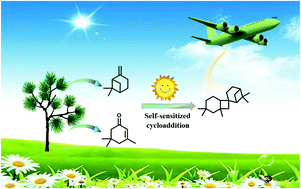
The photoinduced conversion of biomass-derived chemicals to high value chemicals and advanced fuels is of great significance but still challenging. Herein, a green and efficient self-sensitized [2 + 2] cycloaddition process is developed to convert biomass-derived β-pinene and isophorone to spirocyclic molecules, which cannot be achieved by thermal catalytic conversion. The photoreaction can take place with isophorone as the self-sensitizer, with high selectivity and a yield of up to 91.1%. A triplet sensitization mechanism is disclosed by a combination of triplet quenching, phosphorescence quenching, Stern–Volmer kinetic analysis, DFT calculations and photochemical kinetic studies. When combined with hydrodeoxygenation, spiro-fuel is obtained with an overall yield of 85.0% showing a high density of 0.911 g mL−1 which is 16.8% higher than that of conventional aviation kerosene (ca. 0.78 g mL−1), along with excellent cryogenic properties. Notably the self-sensitized cycloaddition strategy can be extended to a wide range of biomass derived α,β-unsaturated ketones and alkenes. Thus, this work provides a promising ring-increasing route to upgrade low-density bio-derived feedstocks to high-density hydrocarbons.
 Please wait while we load your content...


