



How does the flexibility of pyrrolidinium cations affect the phase behaviour of 1-alkyl-1-methylpyrrolidinium bis(trifluoromethanesulfonyl)imide homologues under stressful conditions?†
 c
and
Yukihiro
Yoshimura
*b
c
and
Yukihiro
Yoshimura
*b
Abstract
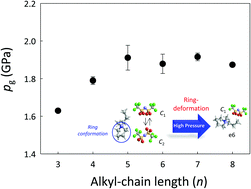
We conducted high-pressure Raman spectroscopy measurements on a series of 1-alkyl-1-methylpyrrolidinium bis(trifluoromethanesulfonyl)imide ([Pyr1n][TFSI], n = 3, 4, 6 and 8) homologues that have different alkyl chain lengths, n, at room temperature. The results showed that all [Pyr1n][TFSI] samples formed a glassy state in which the glass transition pressure (pg) slightly increased with an increase in n. This tendency is similar to prior results of high-pressure glass formation of [Cnmim][TFSI], although the pgs for [Pyr1n][TFSI] are larger than those for [Cnmim][TFSI] with corresponding n by ∼0.5 GPa. We discuss the local structural changes occurring in [Pyr1n][TFSI] in view of the conformational changes of the Pyr+1n cation and TFSI− anion.
 Please wait while we load your content...


