


 PLATFORM UPDATE:

One-pot hydrothermal preparation of gadolinium-doped silicon nanoparticles as a dual-modal probe for multicolor fluorescence and magnetic resonance imaging†
 *ac
and
*ac
and
Abstract
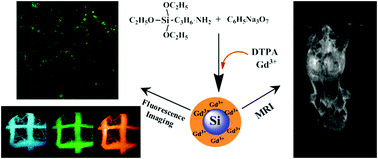
At present, multimodal probes for fluorescence and magnetic resonance imaging based on gadolinium-silicon hybrid nanoparticles have been reported. However, the existing preparations for these nanoparticles usually involve multi-step complicated processes and harsh conditions. Herein, to avoid complex procedures, we conveniently adopted a one-pot hydrothermal method to synthesize gadolinium (Gd)-doped silicon nanoparticles (D-SiGdNPs) using gadolinium chloride and diethylenetriaminepentaacetic acid (DTPA) as dopants. This is the first report on the synthesis of Gd-doped silicon nanoparticles. The D-SiGdNPs presented bright fluorescence (QY: 38%), good stability, and low biotoxicity. In particular, due to the dopants, the nanoparticles exhibited higher longitudinal relaxivity than the commercial contrast agent (Gd–DTPA) and obvious excitation-dependent photoluminescence whose emission wavelength ranged from 467 nm to 557 nm under serial excitation from 400 to 510 nm; thus, these NPs could be used for magnetic resonance imaging (MRI) and anti-counterfeiting stain applications. Moreover, the successful application of D-SiGdNPs, such as in the T1-weight MRI of mice and cellular fluorescence imaging, proves that the D-SiGdNPs have the potential to become an efficient dual-modal nanoprobe for multicolor fluorescence and magnetic resonance imaging in the future.
 Please wait while we load your content...


