


 PLATFORM UPDATE:

A new copolymer based on a D–π–A or D–A–π repeat unit for polymer solar cells employing non-halogenated solvents†
 *ac
*ac
Abstract
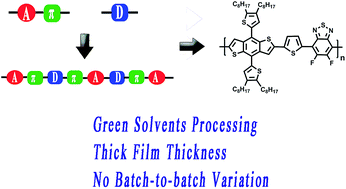
It's a challenge to prepare high-performance polymer solar cells (PSCs) employing non-halogenated solvents due to the poor solubility of conjugated polymers. Here, a new region-random copolymer, in contrast to traditional polymers featuring a D–A or D–π–A–π backbone, is synthesized and fully characterized. By polymerizing ffBT-T (π–A) units with BDT (D) units, the resultant polymer PBDT-ffBT-T (P1T) with repeat units of D–π–A or D–A–π exhibits superior solubility in non-halogenated solvents and outperforms its traditional analogues with the highest performance of 8.53% when processed from anisole. Importantly, the optimal device performance is attained with an active layer thickness of over 200 nm and shows no batch-to-batch difference, implying its compatibility with printing technology. Our results demonstrate that this simple chemical modification for copolymers may significantly benefit the development of PSCs using environmentally friendly solvents.
 Please wait while we load your content...


