Jump to main content
Jump to site search
Access to RSC content Close the message box

Continue to access RSC content when you are not at your institution. Follow our step-by-step guide.


Issue 31, 2018
Previous Article Next Article

Synthesis and biological evaluation of 2-aryl-benzimidazole derivatives of dehydroabietic acid as novel tubulin polymerization inhibitors

Author affiliations

Abstract

A series of novel 2-aryl-benzimidazole derivatives of dehydroabietic acid were synthesized and characterized by IR, 1H NMR, 13C NMR, MS and elemental analyses. All the target compounds were evaluated for their in vitro cytotoxic activity against SMMC-7721, MDA-MB-231, HeLa and CT-26 cancer cell lines and the normal hepatocyte cell line QSG-7701 through MTT assays. Among them, compound 6j displayed the most potent cytotoxic activity with IC50 values of 0.08 ± 0.01, 0.19 ± 0.04, 0.23 ± 0.05 and 0.42 ± 0.07 μM, respectively, and substantially reduced cytotoxicity against QSG-7701 cells (5.82 ± 0.38 μM). The treatment of SMMC-7721 cells with compound 6j led to considerable inhibition of cell migration ability. The influence of compound 6j on cell cycle distribution was assessed on SMMC-7721 cells, exhibiting a cell cycle arrest at the G2/M phase. Moreover, tubulin polymerization assays and immunofluorescence assays elucidated that compound 6j could significantly inhibit tubulin polymerization and disrupt the intracellular microtubule network. A molecular docking study provided insight into the binding mode of compound 6j in the colchicine site of tubulin. In addition, compound 6j was found to induce apoptosis of SMMC-7721 cells, an increase of intracellular ROS level and a loss of mitochondrial membrane potential in a dose-dependent manner. These findings provided new molecular scaffolds for the further development of novel antitumor agents targeting tubulin polymerization.
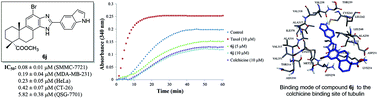
Graphical abstract: Synthesis and biological evaluation of 2-aryl-benzimidazole derivatives of dehydroabietic acid as novel tubulin polymerization inhibitors

Back to tab navigation

Supplementary files

Article information


Submitted
08 Mar 2018
Accepted
30 Apr 2018
First published
16 May 2018

This article is Open Access

RSC Adv., 2018,8, 17511-17526
Article type
Paper

Synthesis and biological evaluation of 2-aryl-benzimidazole derivatives of dehydroabietic acid as novel tubulin polymerization inhibitors

T. Miao, X. Tao, D. Li, H. Chen, X. Jin, Y. Geng, S. Wang and W. Gu, RSC Adv., 2018, 8, 17511
DOI: 10.1039/C8RA02078G

This article is licensed under a Creative Commons Attribution 3.0 Unported Licence. Material from this article can be used in other publications provided that the correct acknowledgement is given with the reproduced material.

Reproduced material should be attributed as follows:

  • For reproduction of material from NJC:
    [Original citation] - Published by The Royal Society of Chemistry (RSC) on behalf of the Centre National de la Recherche Scientifique (CNRS) and the RSC.
  • For reproduction of material from PCCP:
    [Original citation] - Published by the PCCP Owner Societies.
  • For reproduction of material from PPS:
    [Original citation] - Published by The Royal Society of Chemistry (RSC) on behalf of the European Society for Photobiology, the European Photochemistry Association, and RSC.
  • For reproduction of material from all other RSC journals:
    [Original citation] - Published by The Royal Society of Chemistry.

Information about reproducing material from RSC articles with different licences is available on our Permission Requests page.


Social activity

Search articles by author

Spotlight

Advertisements