


 PLATFORM UPDATE:


Facile preparation of hyperbranched glycopolymers via an AB3* inimer promoted by a hydroxy/cerium(iv) redox process†

Abstract
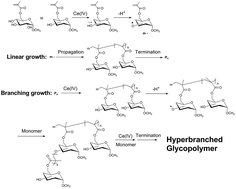
The facile preparation of hyperbranched glycopolymers was performed without protecting group chemistry, where the methyl-6-O-methacryloyl-α-D-glucoside (6-O-MMAGlc) monomer was adopted as an AB3*-type inimer. The polymerization was initiated by the hydroxy/cerium(IV) redox process and could be named the self-condensing vinyl copolymerization/redox (SCVP/Redox) process. The oxygen radical (C–O˙), rather than the carbon radical (˙C–OH), was generated by the redox reaction of Ce(IV) with –OH groups on the pyranose in 6-O-MMAGlc, which was confirmed by NMR data. The formation of the branching point and linear chain growth were defined to give the degree of branching (DB). A linear increase of the DB was observed as the concentration of Ce(IV) increased, implying facile control of the DB. More interestingly, the hyperbranched glycopolymers on the amyloid fibrillation of hen egg-white lysozyme (HEWL) exhibited a greater inhibition activity than that of the linear analogue. This substantial study would provide more room to enrich the family of glycopolymers and extend their potential application in biomedicine and biomaterials.
 Please wait while we load your content...


