


 PLATFORM UPDATE:

Determination of the viscoelastic properties of a single cell cultured on a rigid support by force microscopy

Abstract
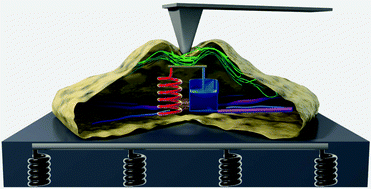
Understanding the relationship between the mechanical properties of living cells and physiology is a central issue in mechanobiology. Mechanical properties are used as fingerprints of the pathological state of a single cell. The force exerted on a cell is influenced by the stiffness of the solid support needed to culture it. This effect is a consequence of the cell's boundary conditions. It causes a cell to appear with mechanical properties different from their real values. Here we develop a bottom effect viscoelastic theory to determine the viscoelastic response of a cell. The theory transforms a force–distance curve into the cell's Young's modulus, loss modulus, relaxation time or viscosity coefficient with independence of the stiffness of the rigid support. The theory predicts that, for a given indentation, the force exerted on the cell's periphery will be larger than on a perinuclear region. Results based on the use of semi-infinite contact mechanics models introduce large numerical errors in the determination of the mechanical properties. Finite element simulations confirm the theory and define its range of applicability.
 Please wait while we load your content...


