


The role of mass spectrometry in radioactive contamination assessment after the Fukushima nuclear accident
 a
Jian
Zheng
*b
and
a
Jian
Zheng
*b
and
Abstract
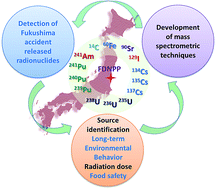
The Fukushima nuclear accident caused the release of large amounts of radionuclides into the environment. After the accident, radioactive contamination assessment in environmental samples is essential for radiation dose estimation and radioactive remediation. Mass spectrometry characterized by high sensitivity, low detection limit, short measuring time, high sample throughput, and the capability to obtain atomic ratios is a promising technique for the analysis of the accident released long-lived radionuclides. This review describes the developed analytical methods based on mass spectrometric techniques for the determination of radionuclides (Pu isotopes, U isotopes, radiocesium, radioiodine, radiostrontium, etc.) with regards to Fukushima samples. The real applications of mass spectrometric techniques for radioactive source identification, radiation protection and geochemical tracing are discussed to highlight the importance of mass spectrometric techniques in radioactive contamination assessment after the accident. Future research prospects of mass spectrometric techniques for the analysis of radionuclides with application to Fukushima samples are briefly outlined.
- This article is part of the themed collection: Recent Review Articles
 Please wait while we load your content...


