


 PLATFORM UPDATE:

Biocompatible supramolecular dendrimers bearing a gadolinium-substituted polyanionic core for MRI contrast agents†

Abstract
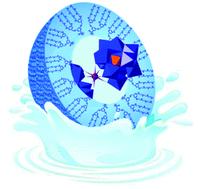
Two cationic dendrons bearing terminal groups of triethylene glycol monomethyl ether in different generations were used to encapsulate a paramagnetic polyoxometalate cluster K13[Gd(β2-SiW11O39)2], in which the Gd3+ ion was sandwiched by the coordination of two lacunary [β2-SiW11O39]8− sub-clusters, through electrostatic interaction. Benefiting from the surface covering of cationic dendrons and ionic complexation, both inorganic polyanionic core and the complexes formed maintained chemical stability in a physiological environment. In addition, the formed charge-neutralized supramolecular complex dendrimers with biocompatible periphery had low cytotoxicity but high relaxivity for in vitro and in vivo magnetic resonance imaging (MRI) in the self-assembled state. Because of the branched structure of organic components on the cluster surface and the disordered packing of complexes in aggregations, a reasonable communication of cluster core with the bulk environment was concluded. Importantly, due to the assembled particle size and molecular weight, the complex dendrimers were a suitable model for liver-specific MRI contrast agents. The results obtained showed that the dendritic supramolecular hybrid complexes represent potential MRI contrast agents in the development of new biomedical materials.
 Please wait while we load your content...


