


 PLATFORM UPDATE:

Reduction-responsive dithiomaleimide-based polymeric micelles for controlled anti-cancer drug delivery and bioimaging†
 *a
*a
Abstract
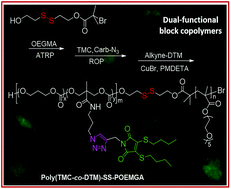
Drug delivery systems integrated with dual or multi-functionalities of stimuli-responsiveness, targeted and controlled release, and bioimaging are favorable in improving the efficiency of chemotherapy. In this study, the amphiphilic block copolymers of poly(TMC-co-DTM)-SS-POEGMA were synthesized via a combination of atom transfer radical polymerization (ATRP) of oligo(ethylene glycol) monomethyl ether methacrylate (OEGMA) and ring opening polymerization (ROP) of two monomers (trimethylene carbonate (TMC) and N3-functional cyclic carbonate monomer (Carb-N3)) on a bifunctional initiator, followed by “click” post-functionalization with alkyne-dithiomaleimide (DTM). The obtained copolymers possessed stimuli-sensitive characteristics and bright fluorescence properties, crucial in achieving the desired therapeutic efficiency. The core-labeled micelles (CLMs) obtained from poly(TMC-co-DTM)-SS-POEGMA showed desirable fluorescence characteristics compared to the alkyne-DTM monomer. Therefore, the material was used directly in cellular uptake studies and exhibited clear green fluorescence. Moreover, the camptothecin (CPT)-loaded CLMs were shown to be stable in aqueous solution and dissociated into their hydrophobic and hydrophilic components in a thiol-rich environment to release CPT. Due to the dual functionalities of reduction-responsiveness and fluorescence, these nanoparticles based on novel poly(TMC-co-DTM)-SS-POEGMA exhibited promising characteristics to be potentially used in cancer chemotherapy.
 Please wait while we load your content...


