


 PLATFORM UPDATE:

A polymer electron donor based on isoindigo units bearing branched oligo(ethylene glycol) side chains for polymer solar cells†
 *a
and
*a
and
Abstract
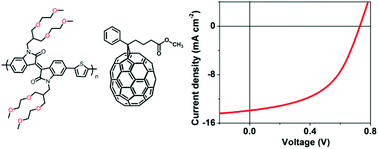
For solution processability of polymer solar cells (PSCs), polymer electron donors are almost always composed of conjugated main chains and flexible alkyl side chains. In this paper, we report a polymer electron donor based on isoindigo units bearing branched oligo(ethylene glycol) (OEG) side chains, P-OEG. Compared with the control polymer bearing alkyl side chains (P-Alkyl), P-OEG exhibits not only a smaller π–π stacking distance and redshifted absorption spectra, but also larger surface energy for better compatibility with the [6,6]-phenyl-C71-butyric acid methyl ester (PC71BM) electron acceptor. The PSC device of P-OEG exhibits an open-circuit voltage (VOC) of 0.73 V, short-circuit current density (JSC) of 13.92 mA cm−2, and fill factor (FF) of 0.50, corresponding to the power conversion efficiency (PCE) of 5.10%. This performance is higher than that of P-Alkyl (PCE = 3.0%), which is attributed to the finer phase separation morphology of the P-OEG:PC71BM blend than that of the P-Alkyl:PC71BM blend. These results suggest that the branched OEG side chain is an effective approach to improve the PSC device performance of some polymer electron donors.
 Please wait while we load your content...


