


 PLATFORM UPDATE:

Superbase ionic liquids for effective cellulose processing from dissolution to carbonisation†

Abstract
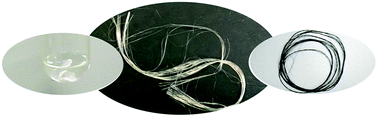
A range of superbase derived ionic liquids (SILs) was synthesised and characterised. Their ability to dissolve cellulose and the characteristics of the produced fibres were correlated to their specific structural and solvent properties. 17 ionic liquids (ILs) (including 9 novel) were analysed and six ILs were selected to produce fibres: 1-ethyl-3-methylimidazolium acetate [C2C1im][OAc], 1-ethyl-3-methylimidazolium diethyl phosphate [C2C1im][DEP] and the SILs 1-ethyl-1,8-diazabicyclo[5.4.0]undec-7-enium diethylphosphate [DBUEt][DEP], 1,8-diazabicyclo[5.4.0]undec-7-enium acetate [DBUH][OAc], 1,5-diazabicyclo[4.3.0]non-5-enium acetate [DBNH][OAc] and 1-ethyl-1,5-diazabicyclo[4.3.0]non-5-enium diethylphsophate [DBNEt][DEP]. The mechanical properties of these fibres were investigated. The obtained fibres were then carbonised to explore possible application as carbon fibre precursors. The fibres obtained using a mixture of 1,5-diazabicyclo[4.3.0]non-5-enium based SILs with acetate and hexanoate anions (9 : 1), [DBNH][OAc][Hex], showed a promising combination of strength, stiffness and strain at failure values for applications in textiles and fibre reinforcement in renewable composites. Using Raman spectroscopy it is demonstrated that these fibres exhibit a relatively high degree of structural order, with fewer defects than the other materials. On the other hand, analogous fibres based on imidazolium cation with acetate and hexanoate anions (9 : 1), [C2C1im][OAc][Hex] showed a decline in the quality of the produced fibres compared to the fibres produced from [C2C1im][OAc], [C2C1im][DEP] or [DBNH][OAc][Hex].
 Please wait while we load your content...


