


 PLATFORM UPDATE:

Primary vs. secondary H-atom abstraction in the Cl-atom reaction with n-pentane†

Abstract
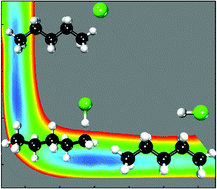
Velocity map imaging (VMI) measurements and quasi-classical trajectory (QCT) calculations on a newly developed, global potential energy surface (PES) combine to reveal the detailed mechanisms of reaction of Cl atoms with n-pentane. Images of the HCl (v = 0, J = 1, 2 and 3) products of reaction at a mean collision energy of 33.5 kJ mol−1 determine the centre-of-mass frame angular scattering and kinetic energy release distributions. The HCl products form with relative populations of J = 0–5 levels that fit to a rotational temperature of 138 ± 13 K. Product kinetic energy release distributions agree well with those derived from a previous VMI study of the pentyl radical co-product [Estillore et al., J. Chem. Phys. 2010, 132, 164313], but the angular distributions show more pronounced forward scattering. The QCT calculations reproduce many of the experimental observations, and allow comparison of the site-specific dynamics of abstraction of primary and secondary H-atoms. They also quantify the relative reactivity towards Cl atoms of the three different H-atom environments in n-pentane.
 Please wait while we load your content...


