


 PLATFORM UPDATE:

Comparative experimental and theoretical study of the rotational excitation of CO by collision with ortho- and para-D2 molecules
 ab
ab
Abstract
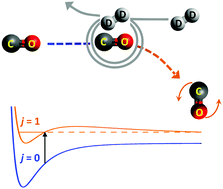
A joint crossed beam and quantum mechanical investigation of the rotationally inelastic collisions of CO with ortho- and para-D2 molecules is reported. A new 4D potential energy surface (PES) averaged over the ground vibrational states of D2 and CO is used to calculate the rovibrational bound states of the ortho-D2–CO complexes. Close coupling calculations are then performed in the rigid rotor approximation for ortho- and para-D2 colliding with CO for the experimentally investigated transition of CO (j = 0 → 1) and for collision energies ranging from 0.1 to 25 cm−1. The agreement between theory and experiment is found to be very good for both the bound state energies of the ortho-D2–CO complexes and for the inelastic scattering cross-sections showing that the free rotation of two rigid rotors is a very good model of the D2–CO system in this low collision energy domain.
 Please wait while we load your content...


